


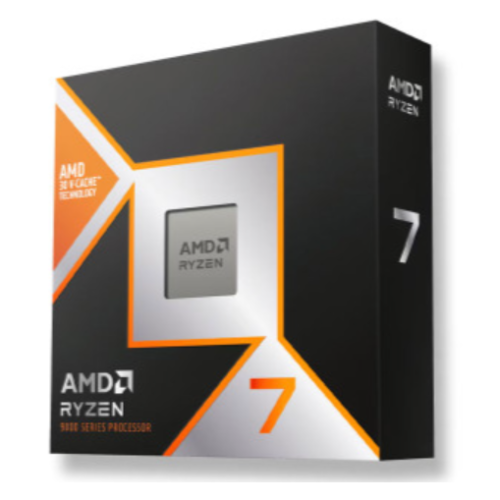
| Processor | ||
| Cache | L1 Cache: 640 KB L2 Cache: 8 MB L3 Cache: 96 MB |
|
| Cores | 8 | |
| Threads | 16 | |
| Base Frequency | 4.7 GHz | |
| Maximum Turbo Frequency | Up to 5.6 GHz | |
| Processor Graphics | AMD Radeon™ Graphics | |
| TDP | Default TDP: 120W | |
| Maximum Size | 192 GB | |
| Warrantty | 03 years | |
The AMD Ryzen 7 9850X3D is the definitive gaming flagship of the Zen 5 "Granite Ridge" era. Released on January 29, 2026, with an MSRP of $499, it arrived as a higher-binned, mid-cycle refresh of the highly acclaimed 9800X3D. While it maintains the same 8-core, 16-thread configuration, its primary purpose is to cement AMD's lead as the provider of the world’s fastest gaming processors.
The 9850X3D utilizes AMD’s 2nd Generation 3D V-Cache technology. In this refined design, the 64MB cache die is placed underneath the CPU cores rather than on top. This architectural flip allows the cores to make direct contact with the integrated heat spreader (IHS), resulting in significantly better thermal dissipation.
Frequency Boost: Thanks to improved thermals and superior silicon binning, the 9850X3D pushes the boost clock to a staggering 5.6 GHz—a 400 MHz increase over the 9800X3D.
Cache Capacity: It features a total of 104MB of cache (96MB L3 + 8MB L2), providing the massive on-chip memory pool that allows games to bypass slower system RAM.
In real-world benchmarks, the 9850X3D offers a 3–7% performance uplift in gaming over its predecessor, with even wider margins—up to 27%—when compared to Intel’s flagship Core Ultra 9 285K.
Socket AM5: It remains a drop-in upgrade for existing AM5 motherboards (X670, B650, X870E) via a BIOS update.
TDP and Power: While it retains a 120W TDP rating, users should note that the higher clock speeds can lead to a ~30% increase in actual power draw during heavy gaming compared to the 9800X3D.
Get specific details about this product from customers who own it.

-min-80x80.png)
