


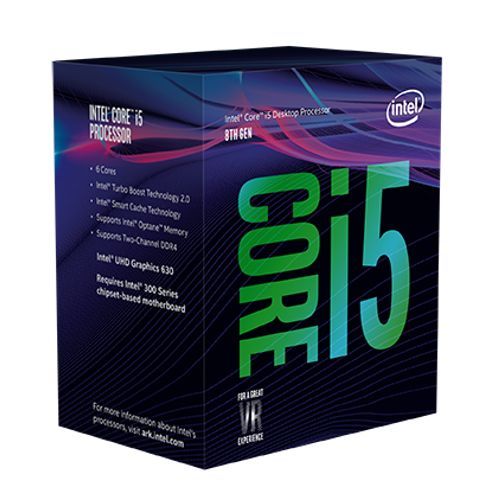
| BASIC INFORMATION | ||
| Base Frequency | 3.00 GHz |
|
| Brand | Intel |
|
| Cache | 9 MB SmartCache |
|
| Cores | 6 |
|
| Default TDP | 65 W | |
| Maximum Turbo Frequency | 4.40 GHz |
|
| Model | i5-9500 |
|
| Threads | 6 |
|
| GRAPHICS SPECIFICATIONS | ||
| Base Frequency | 3.00 GHz |
|
| Core Count | 6 | |
| Max Dynamic Frequency | 1.05 GHz |
|
| Max Resolution | Max Resolution (HDMI 1.4)‡: 4096x2304@24Hz Max Resolution (DP)‡: 4096x2304@60Hz Max Resolution (eDP - Integrated Flat Panel)‡: 4096x2304@60Hz |
|
| Max Video Memory | 64 GB |
|
| Processor Graphics | 630 |
|
| MEMORY SPECIFICATIONS | ||
| Max Number of Channels | 2 | |
| Maximum Size | 128 GB |
|
| Maximum Speed | 2666MHz |
|
| Type | DDR4 |
|
| WARRANTY INFORMATION | ||
| Manufacturing Warranty | 03 Years of Warranty | |
This i5-9500 Processor comes with Intel UHD Graphics 630 graphics. This 9th gen Coffee Lake microarchitecture is manufactured with the 14nm process that comes with six cores but lacks HyperThreading. As this chip is updated to the latest BIOS revision, it nicely fits into any Intel 300-series motherboard. Focusing on this, all the major motherboard manufacturers have already started BIOS updates for their 300-series lineup. This Processors also support 64-bit computing on Intel architecture requires an Intel 64 architecture-enabled BIOS.
Intel 9th Generation Core i5-9500 Processor having the base frequency of 3.00 GHz that can be reached as max turbo frequency at 4.40 GHz. It has a SmartCache of 9 MB containing 6 cores and 6 threads. With a bus speed of 8 GT/s, it has thermal design power (TDP) rating of 65W. This latest microchip has few expansion options such 3.0 PCI express revision having configured up to 1×16, 2×8, 1×8+2×4 and maximum 16 lanes. Considering the memory this processor has a dual-channel of max 128GB of the size that supports up to DDR4-2666 bus speed.
On the process of advance technology this processor has 2.0 Intel turbo boost and Intel virtualization that is directed to I/O (VT-d). This Optane Memory supported chip also has Intel VT-x with extended page tables (EPT). Furthermore, Enhanced Intel SpeedStep and Intel Identity Protection Technology are integrated to increase its efficiency. This exclusive processor comes with 03 years of warranty facility.
If you weren’t tempted by Intel’s Core i5-9400 and want a little more grunt as well as integrated graphics to use either as a backup or as a full-time GPU for a non-gaming rig, then stepping up to the Core i5-9500 might make a bit more sense. As well as faster clock speeds, this CPU costs just a fraction more, and unlike the Core i5-9400, while there is an F-edition that lacks integrated graphics, you only save a meagre 6, meaning you may as well for the full-fat version we’re looking at today.
So, what benefits do you get over the Core i5-9400 and Core i5-9400F? Well, we’re still talking about a 14nm six-core CPU that lacks hyper-threading so you also get six threads – here there’s no difference compared to the Core i5-9400. The cache structure is the same, too, with 256KB L2 cache per core and 9MB total L3 cache. We’re also still dealing with a 65W TDP.
There’s a slight tweak to the Intel UHD Graphics 630 processor, which stands at 1.1GHz maximum dynamic frequency compared to 1.05GHz for the Core i5-9400, but that’s certainly not worth even the additional £10 you’d be spending. The key difference, then, is some extra clock speed. While the Core i5-9400 maxed out at single-core turbo boost of 4.1GHz and could hit 3.9GHz across all cores, the Core i5-9500 is able to aim a little higher, with a 4.4GHz single-core turbo and 4.1GHz all-core boost frequency.
These are both significant as the closer those frequencies get to 5GHz, the less you’ll be losing out to far more expensive CPUs such as the Core i9-9900K in games, plus Intel can start reeling in AMD, which has a distinct advantage at this price in terms of multi-threaded grunt. Sure, the increases might seem minimal compared to your typical overclock on a K-series CPU, but if you’re in the market for a Core i5-9500 then you probably aren’t concerned with all that unlocked-multiplier malarky anyway. What matters is whether those extra clocks result in something tangible in lightly-threaded and multi-threaded workloads, or whether the Core i5-9400F is still the way to go.
Get specific details about this product from customers who own it.

